
Monday, June 27, 2011


Friday, June 24, 2011
Not just a temple
Another post from my blog (http://dear-mr-anonymous.blogspot.com/) about our bodies and being grateful :)
Enjoy <3, Kelly
Dear Mr. Anonymous,
My body is not just my temple...
My body is my utopia. My church. My heaven. My best friend.
My body is a jungle gym, a fork lift, a crane, and a ball.
My body is my ticket to exotic lands.
My body is my altar, which I can adorn how I wish to...with colors and spunk.
My body is my home.
I hope that your body is not just a temple.
But, regardless of what your body is, you MUST take care of it. Fuel it. Nourish it. Play with it. Cheerish it. Nurture it. Care for it. Never, never stop loving it. Ever.

We so often do not realize the amazing things our bodies do for us daily. We criticize our bodies rather than being grateful for their endless giving.
No one's body is a mistake. Each one is unique and perfect in its own way.
Our legs carry us to distant places. Our arms can pick up our children and embrace our loved ones. Our noses can smell wonderful, deliscious foods. Our tummies house our future little ones for the first nine months of our lives while they grow into this world. Our eyes let us see magnificent, awe-grasping landscapes. Every little bit of our bodies are beautiful. Please see this.
If you are not blind or deaf; if you have two legs and arms; if your body can support a child; if you can walk, run, bike; if you can wiggle your toes; if you can eat and digest warm meals; if you can sing (well or badly); if you can sit up in the morning; if you even wake up in the morning; say thank you to your body.
Stop dwelling over your weight. At least you have food to eat.
Stop obsessing over how white your teeth are. At least you have them and runnimg water to brush with.
Stop hating your legs. At least you have a bed to rest them on at night.
Stop being distraught over that tiny pimple. At least you have soap and the means to bathe each day.
Stop fixating on how your clothes look on you. At least you have clothes to keep you warm in the winter.
Be grateful for these things and all that your body does for you <3
Enjoy <3, Kelly
Dear Mr. Anonymous,
My body is not just my temple...
My body is my utopia. My church. My heaven. My best friend.
My body is a jungle gym, a fork lift, a crane, and a ball.
My body is my ticket to exotic lands.
My body is my altar, which I can adorn how I wish to...with colors and spunk.
My body is my home.
I hope that your body is not just a temple.
But, regardless of what your body is, you MUST take care of it. Fuel it. Nourish it. Play with it. Cheerish it. Nurture it. Care for it. Never, never stop loving it. Ever.

photo credit: AirMa519
We so often do not realize the amazing things our bodies do for us daily. We criticize our bodies rather than being grateful for their endless giving.
No one's body is a mistake. Each one is unique and perfect in its own way.
Our legs carry us to distant places. Our arms can pick up our children and embrace our loved ones. Our noses can smell wonderful, deliscious foods. Our tummies house our future little ones for the first nine months of our lives while they grow into this world. Our eyes let us see magnificent, awe-grasping landscapes. Every little bit of our bodies are beautiful. Please see this.
If you are not blind or deaf; if you have two legs and arms; if your body can support a child; if you can walk, run, bike; if you can wiggle your toes; if you can eat and digest warm meals; if you can sing (well or badly); if you can sit up in the morning; if you even wake up in the morning; say thank you to your body.
Stop dwelling over your weight. At least you have food to eat.
Stop obsessing over how white your teeth are. At least you have them and runnimg water to brush with.
Stop hating your legs. At least you have a bed to rest them on at night.
Stop being distraught over that tiny pimple. At least you have soap and the means to bathe each day.
Stop fixating on how your clothes look on you. At least you have clothes to keep you warm in the winter.
Be grateful for these things and all that your body does for you <3
Monday, June 20, 2011
Intuitive Eating
Here's a post from my blog at http://dear-mr-anonymous.blogspot.com/ that I wanted to share with you all concerning my philosophy of eating :) dig in!
Dear Mr. Anonymous,
A friend dear to my heart has prompted me today to share my stories and thoughts on eating with the universe. He is currently struggling with something I run into daily: getting others to see the joys and freedom that come from eating intuitively and abandoning the restrictive lives we follow.
Here are my thoughts:
That intuitive eating could possibly be the answer is hard enough on its own for someone to believe, let alone for him/her to convince others of. Believe me. I encounter people on a daily basis that are suffering terribly, trapped in the viscous cycle of restricting their bodies of essential desires and needs. However, it is not their fault; we are all brought up to believe certain societal lies: there are good foods and bad foods, any amount of fat on the body is unhealthy, if I eat "junk" food I will self-destruct, and the list goes on. While we are born intuitive eaters, this right is quickly stripped from us before we even have the chance to decide our path for ourselves.
In society, we are bombarded by signs that we do not know how to eat on our own and need external cues and sources to tell us what to eat, how much to eat, when to eat, and basically, to control our every decision. However, internally, our bodies are constantly fighting and trying their very hardest to show us that they know what's best. From the day we come into this world, our bodies are able to acknowledge the basic instincts of hunger: a baby cries when he or she needs nourishment, our tummies churn and grumble when our energy levels are low and our bodies need fuel, we tire when we have exerted ourselves without rest, we start to salivate and think about food as our hunger builds...Our bodies know best what they need and no external source can replace our innate, internal wisdom.
Intuitive eating is a promise to ourselves to take care of our bodies; to nourish ourselves physically, emotionally, intellectually, and spiritually; to give into our cravings and desires; and to be compassionate and kind to ourselves by tending to our needs and making sure they are met.
Intuitive eating is nourishing our bodies with food when they are physically hungry and differentiating this from emotional hunger. Intuitive eating is tapping into our physical hunger, acknowledging it, and tending to it. And when we are satisfied and full, intuitive eating stopping eating and carrying this new energy into our lives so that we can be fully present and aware. Intuitive eating is allowing our bodies to crave what they want and then to give it to them, because they know best what they need to strive. At first, intuitive eating is scary and lacks the security of being controlled by external cues, so we can expect mess ups; sometimes we may forget care for ourselves and we may go hungry for a while, sometimes we may be presented with a delicious meal and overindulge, sometimes we may feed our emotional hunger with food rather than connecting to ourselves and fulfilling its true needs. All of these mistakes are solely moments in time and will pass; our hunger will grow so strong that we are forced to tend to it, the uncomfortable feelings caused by overeating will soon dissipate and it will take a bit longer for us to once again be hungry, and we will recognize that shoveling our emotions down with food does not allow us to feel them and truly move through them. Relearning how to eat intuitively requires time, patience, trust, and openness. While, we may have forgotten how to feel our hunger, tend to it, and be satisfied and full, we never completely lose intuitive eating...it just needs to be rediscovered.
Time to bust through some of the myths people hold:
1. "Sweets/carbs/etc. are bad and if I allow myself to eat them I will never stop and my body will explode. "
Okay, all food breaks down to energy in the end, which our bodies need to survive, so how is it that anything that sustains life and fuels our bodies be "bad"? When we put restrictions on our eating and categorize food as "good" or "bad", we give food a power that it shouldn't possess. When candy/carbs/etc. are labeled "bad" we restrict ourselves of them and tell our bodies "no" when they crave their deliciousness and sweet energy. Not allowing ourselves to have what we crave only heightens those cravings making them stronger and all the more powerful. Two outcomes can come from this restriction of diet:
a. As with 98% of dieters that end up gaining back all of their lost weight (plus some), there is this mind set: "I ate one bite of (insert "bad" food here), I have failed my diet so I should continue to stuff myself since I have already screwed up. My diet will start again tomorrow. And I will restrict my life once more." If people were to just offer their bodies the food they initially desired, they may have been able to just eat the amount they wanted, until satisfied, and move on with the rest of their day, not giving food that power over their lives, end even perhaps not craving that food again for a few hours, days, weeks, or even months... Instead, they are left to berate, scold, and punish themselves by reinstating their diets (continuing the viscous cycle of restricting and binging).
b. The other 2% of dieters who keep the weight off (keep in mind that this 2% includes many with eating disorders) have this mindset: "I am okay, happy, and successful, right? I didn't give into my cravings and bodily desires. I am restricting, losing weight, and ignoring my body's needs. I may not be happy doing this but once I am skinny I will be and my life will be perfect. I will forever not listen to my body and have restrictions on my diet and my life." Sounds like a great way to live, eh?
However, there is another option. By allowing ourselves to eat what we want, we do not give food this power over our lives. We find that we are able to eat what we crave, be satisfied and full, and move on to our next venture. All foods are equally good and provide us the energy to live, engage, and grow. By not putting labels on food we are able to solely eat them when we want to and the constant craving for a particular food slowly subsides over time. Trust me, when I first started eating mindfully and intuitively I wanted a peanut butter and jelly sandwich everyday (this was a food that I did not allow myself to eat when I was anorexic). After 2 straight months of eating pb & j everyday, I lost this persistent craving for it and now only have it every few weeks when my body craves it. While it did take a while for this once forbidden food to lose its power, it eventually happened. This has been the case for countless other, once off-limit foods (candy, white bread, butter, pasta, cheese, etc.). Okay...maybe I still eat candy daily...but I'm still alive and haven't spontaneously combusted yet.
2. "My body will never, ever crave fruit, vegetables, and other nutritious foods"
While it may take a while for your body to desire a wide variety of foods, trust me, it will happen. The first and most important principle of intuitive eating is learning to recognize hunger and fullness and follow those bodily cues. Once this is achieved the nutrition aspect of intuitive eating is added to the mix. When I first started eating intuitively I only wanted carbs and sweets. But gradually, over a long period of time, once I had given myself full permission to have whatever I wanted, a started to crave new foods that I had never previously desired. I noticed that after a few days of eating solely carbs, my body started to crave salads and smoothies all the time. I went an entire day of just eating fruit! Not because I thought I should but because my body craved those nutrients and my hunger called for fruit. Our bodies have their own internal food period and will crave a variety of food once we allow ourselves permission to eat anything and the line between "good" and "bad" food fades away. While I do not eat every food group on a daily basis, if you were to observe my eating patterns over a week, month, or year, you will see that my body naturally craves all sorts of foods (carbs, fruits, veggies, meat, dairy, sweets, fats, etc.). It now makes sense to me why when I first started eating intuitively I solely longed for carbs. At the time I was not feeding myself enough, so my body craved high-energy foods such as sweets and carbs. I notice this happening even now. When my energy is low and I am very hungry, I don't crave vegetables, but instead, high-calorie foods. Is this whole intuitive eating thing starting to make sense yet??
3. "I can't be at a healthy weight. My butt is big and round, my thighs have dimples, and my tummy sticks out."
Weight and size DO NOT indicate health! When I weighed 110 pounds and was anorexic I went on a mountaineering trip in Colorado. I was unable to keep up with the group because I was too week and under-nourished. I had to leave the month long excursion on Day Two and go to the hospital. About three years later, now at a healthy weight for my body, I am able to hike while talking with my friends, go rock climbing and lift my body weight over a ledge, and have the energy to explore and play all day long. I am active and healthy but by BMI standards I was healthier when I was anorexic and nearing death. Yes, I have a belly but what is wrong with that? It tags along when I go outside and play, it provides a cushion when I lie on my stomach, it is soft and sensual.
We are constantly bombarded with messages that we must be stick thin with no fat at all to be healthy. If this is true why do many people at a "normal" weight have poorer health than those considered "overweight" who are active? There are countless measures that affect and tie into our health and having some body fat is not the all-determining factor. Just take a trip here:http://www.haescommunity.org/ .
Our obsession with being skinny stems from society. We are told that we will be happy once we are thin, our lives will finally begin, and all will be perfect. Trust me, I've been there and it's bullshit. We achieve happiness through living and embracing our lives, through loving and accepting ourselves and others as we are, and through staying present to the moment rather than waiting for our lives to one day begin. That there is the secret to life, my friends.
I'm ready to go out and start exploring Dublin once more so it's time to wrap up!
I really hope that my ramblings and thoughts give you something because the joy and freedom of intuitive eating is life changing for those who suffer from a restrictive menu and lifestyle. And all of these messages can be applied to every aspect of life beyond eating. Great happiness comes from fulfilling our longings and desires.
My last message to you is that if you keep bumping heads with someone who is not ready to be open to the possibilities of intuitive eating and you just seem to not be getting through to them, just let it be. While you can try to compassionately present this approach as an option, you cannot force anyone into it. Some people may just not be ready yet and some people will never be ready. It is sad, but it is the truth. You can solely be there when others turn to you and share your internal wisdom with the world. In the meantime focus that energy on yourself and the care you require! <3
Sunday, May 29, 2011
Tuesday, May 17, 2011
To BE or To Be Looked At?
From AdiosBarbie.com:
By Lexie Kite at BeautyRedefined.net; Cross-posted with permission.
 Norman Rockwell's "Girl at the Mirror"You are capable of much more than being looked at.
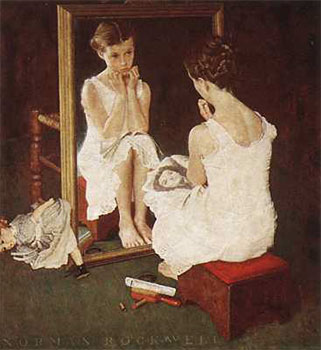
Norman Rockwell's "Girl at the Mirror"
Have you thought about this statement? Do you understand the gravity of it? This was the first of the four messages Lindsay and I carefully chose for our billboard campaigngoing up in June, and it gave me goosebumps when I let it sink in. Women are always being looked at. And when we aren’t being looked at, we are too often envisioning ourselves being looked at, as if an outsider’s perspective has become our own. In fact, our work makes one thing very clear: Part of growing up female today means learning to view oneself from another’s gaze.
Ever heard this quote? Men act and women appear. Men look at women. Women watch themselves being looked at. This determines not only most relations between men and women but also the relation of women to themselves. The surveyor of woman in herself is male: the surveyed female. Thus she turns herself into an object—and most particularly an object of vision: a sight. (John Berger, Ways of Seeing, 1977).
This insightful man was referring to the idea of “objectification,” which we’ve all heard once or twice. But when we think of the term, we probably think of sexualized female bodies, or sexualized parts of female bodies…which isn’t the whole idea here. When we understand the whole of objectification, we can better grasp the role it plays in our daily lives and the ways it may keep us from fulfilling all we want to do with our days. When we travel around giving our one-hour Beauty Redefined visual presentation, we explain to our audiences that objectification takes on many roles:
Say you’re walking down the sidewalk on a beautiful day. Someone who has internalized an outsider’s perspective of herself will often spend more time adjusting her clothing or hair, wondering what other people are thinking of her, judging the shape of her shadow or reflection in a window, etc. She will picture herself walking – she literally turns herself into an object of vision – instead of enjoying the sunny weather, looking around, thinking about anything else, etc. If you find yourself the victim of this type of activity, you aren’t alone. In fact, you are just one of millions of females growing up in a world that teaches us to survey ourselves every waking moment. Profit-driven media tells us how we can “Look Hotter From Behind!” in fitness magazines, “Look Wow Now!” on makeover shows every hour of every day, “Look 10 Years Younger!” using every anti-aging procedure and product under the sun. Notice the emphasis on looking…Do you find you survey yourself as you move through life? That you ever turn yourself into an object of vision: a sight?
You are capable of much more than being looked at. Do you know who you are?Have you grasped the powerful role you can play in a world so badly in need of your unique talents, wisdom, and light? Are you aware of your unique mission at this point in your life? You’ve got something great to do, that only you can do. And if you are here to be looked at, to appear, to survey yourself instead of do an inspirational work that only you can do, you are not fulfilling your mission. Cheesy? Yes. True? Oh yes. More true than you know.
I see objectification playing out in my own life in many ways. Here are two: When I’m walking past people, I always imagine what I look like to them – from the front and from behind – and think irrational thoughts about what the people walking behind me or past me think about me. I often adjust my clothing to what I assume is the most flattering position as I walk. I can admit I’ve been known to look at my own Facebook profile to see what I look like to the cute guy who just added me or the friend I just added. I look through my photos and try to gauge my looks from the perspective of someone who is not me. If that isn’t self objectification, I don’t know what is! Tell me I’m not alone in doing this…? I am a body image activist and I’m getting a Ph.D. in research on self-objectification, yet I still spend time envisioning myself from an outsider’s perspective instead of moving on to so many things more meaningful and productive. This just goes to show it’s a constant battle. I am constantly working to remind myself I’m capable of much more than being looked at. My self-objectification is complicated by the fact that I am an identical twin, so in some ways I see a body of a person with identical DNA in real life in a way that most people cannot experience. Unless you have an identical counterpart, your vision of yourself comes from photos, videos, and your two-dimensional reflection.
So let’s talk about mirrors, shall we? Even as I sit in my bedroom typing at 2 a.m., I see a full-length mirror peeking through the closet door, one with hooks hanging all my jewelry, five small decorative mirrors, and an IKEA centerpiece mirror above my bed. While I don’t think I’m necessarily vain or image-obsessed, I spend 45 minutes in front of the mirror every morning, keep a compact in my purse at all times, and apparently have about 100 in my room for safe keeping. I am surveying an image of myself for at least one of the 24 hours in my day, and imagining that image of myself as I move throughout my day. What role do mirrors play in your life? “Women are constantly being looked at. Even when we’re not, we’re so hyperaware of the possibility of being looked at that it can rule even our most private lives.Including in front of our mirrors, alone,” says Autumn Whitfield-Madrano at her always inspirational website, The Beheld.
The thought-provoking Autumn is currently undergoing an experiment which I cannot deny reflecting upon: A month-long break from mirrors. Thirty-one days of no mirrors, store windows, shiny pots, spoons, or the dark glass of the NYC subway she rides daily. In her own words: There’s nothing wrong with looking in the mirror. There’s nothing wrong with sometimes looking to your reflection—even when it is impossibly subjective, and backward at that—for a breath of fortitude, centeredness, and assurance. I just want to see what life is like when I’m not using that image as my anchor; I want to see how it affects the way I move through the world, the way I regard myself and others. I want to know what it’s like to sever a primary tie to one of my greatest personal flaws—extraordinary self-consciousness—and I want to discover what will fill the space that the mirror has occupied until now.
She goes on: Sometimes I look in the mirror and see myself, or whatever I understand myself to be. Other times, I distinctly see an image of myself. When I see my image reflected on a mirror behind a bar I think, Oh good, I look like a woman who is having a good time out with friends. Or I’ll see my reflection in a darkened windowpane, hunched over my computer with a pencil twirled through my upswept hair, and I’ll think, My, don’t I look like a writer? You’ll notice what these have in common: My thoughts upon seeing my reflection are both self-centered and distant. I’m seeing myself, but not really—I’m seeing a woman who looks like she’s having a good time, or a writer, etc.
Autumn’s insights echo Berger’s powerful words. Too often, we travel through life with an outsider’s vision of ourselves. We are to be looked at. We watch ourselves being looked at. We become objects of vision: sights. But isn’t there so much more to life than watching ourselves self-consciously stroll through it? Life is beautiful when you live it – really experience it – not when you are more concerned about appearing beautiful as you try to live. When you think of your happiest times, were they in front of the mirror? Were you happiest when you were working to appear happy or attractive or beautiful to others? Happiness and beauty come from doing, acting, being – outside the confines of being looked at. So, today, what will you do to shake off the outsider’s gaze you envision of yourself? Will you do as Autumn has done and experiment with what your life becomes when you spend less time with your reflection and more time doing, acting, and being? Will you enjoy the world around you instead of hoping others are enjoying their view of you? Will you do something your self-policing outsider’s gaze kept you from doing before – like speak in front of a group of people? Run without worrying about the jiggle? Go to the store without your makeup on?
Today is the day to remember you are capable of much more than being looked at. And when you begin to realize that, you can start realizing the power of your abilities and the good you can do in a world so desperately in need of you. NOT a vision of you, but ALL of you. What will you find you are capable of?
Wednesday, May 11, 2011
NEW! BAM Committees Coming Soon!
The Body Acceptance Movement
Committee Organization, Leadership, and Responsibilities:
Committee Responsibilities. Each committee, aside from the NEDA
Walk committee, is required to plan and execute at least one event
every other month.
This will keep the club extremely active! At least one “event”
every week. Events can include Girls’ Place Workshops, Tabling,
or Fundraisers, depending on the committee, and can be as small
or as large as you want it to be.
Meeting Schedule. Club meetings will be held every other week, and
E-board meetings will be held on weeks between club meetings. All
members are encouraged to attend e-board meetings to share thoughts
and ideas, but only committee chairs are required to attend.
Committee Organization, Leadership, and Responsibilities:
- Financial Affairs and Fundraising – ?
- Budget
- Manage bank account
- Plan and execute fundraisers
- Look into business sponsorships or other ways to raise
- Money for events
- Apply for SG Funding
- Community Outreach – Nia Brisbane?
- Girls’ Place
- Possible mentoring program with Big Brothers Big Sisters or involvement in local schools or aftercare programs
- Communications, Advertising, and Recruitment – Kelly Ulmer
- Responsible for updating the website and facebook pages
- Record and distribute minutes at club and e-board meetings
- Advertise various events through
- Banners
- Posters/flyers
- Etc.
- New member recruitment
- NEDA Walk – Ashley Hunter
- Plan and execute NEDA walk event, including:
- Necessary fundraising
- Advertising
- Partnerships with local businesses or other organizations
- BAM committees will provide support if needed
- Campus Involvement - ?
- Plan and execute events on campus, including:
- Film screenings
- Tabling activities
- Partnerships with other student organizations
- Etc.
- Socials and Club Events – Rebecca Astorga
- Plan and execute events for members of the Body Acceptance Movement to attend, including:
- Dinners
- Outdoor activities (Lake Wauberg, Tubing, etc.)
- End of the year/semester banquets
- Provide refreshments and snacks for most of the club meetings
- Can be donated by an outside source or provided by volunteers
- Director – Simone Pierson
- Compose agendas for e-board and club meetings
- Facilitate communication within the club and committees
- Do whatever it takes to help BAM be successful
- Faculty Advisor – Shannon Kirkpatrick
- Make sure we are doing a good job
- Be awesome!
Committee Responsibilities. Each committee, aside from the NEDA
Walk committee, is required to plan and execute at least one event
every other month.
This will keep the club extremely active! At least one “event”
every week. Events can include Girls’ Place Workshops, Tabling,
or Fundraisers, depending on the committee, and can be as small
or as large as you want it to be.
Meeting Schedule. Club meetings will be held every other week, and
E-board meetings will be held on weeks between club meetings. All
members are encouraged to attend e-board meetings to share thoughts
and ideas, but only committee chairs are required to attend.
Friday, May 6, 2011
Scale Back: It’s International No Diet Day!
The following is from adiosbarbie.com!

"When I lose these last ten pounds, I'll go to the beach."
"Next week I'll eat more. I've got to fit into that dress this weekend."
"I can't eat that! It'll go straight to my hips."
Sound familiar? Have you put any thought into the actual quantity of time that you spend thinking about your body and/or food? Pay attention. You might surprise yourself at how much brain space is devoted to calculating calories, self-loathing, and deprivation. Have you ever imagined the relief you would feel if you could abandon the quest to obtain the ideal body? If you haven’t, it’s time to liberate yourself from the no-win game of dieting. May 6th is the perfect day to start.
Since 1992, May 6th has been designated International No Diet Day (INDD). This body-loving campaign is associated with combating eating disorders and honoring the people who have suffered because of one. For this day, we can thank Mary Evans Young, a UK feminist, the founder of the British anti-diet movement, Diet Breakers, and author of the best-selling book, Diet Breaking: Having It All Without Having To Diet (Hodder & Stoughton, 1995). She started INDD after recovering from anorexia, although the day isn’t just about eating disorders. This movement draws attention to the fact that a great many of us suffer from disordered thinking regarding food and our bodies, not just those afflicted with anorexia and bulimia.
INDD is more about not depriving yourself for a 24-hour period. It beckons you to make peace with your body and your relationship with food. And not only for your mental health. Various studies show that yo-yo dieting has been found to be damaging to one’s physical health in conditions such as congestive heart failure, hypertension, and clogged arteries. What’s more is that investigators have evidence that illustrate a significant correlation between thinness and shorter lives.
As you savor in the freedom and pleasure of eating exactly what you please this May 6th, contemplate that every single day could be diet-free. Easier said than done. Chances are, if you diet you’ve been counting calories for a long time. Abandoning the habit isn’t going to happen overnight. It’s a process – one that leads to greater self-acceptance. Start small. If you need some help, choose one of the following actions to start creating a new diet-free reality:
- If you regularly weigh yourself, cut down how often you do with the goal of getting rid of your scale completely. Celebrate by throwing a scale-smashing party.
- Stop asking, “Do I look fat in this?” Make the commitment to stop questioning your friends, your lover, and especially yourself for a full week. Then, at the end of that week, commit for another week and then another, until you have deprogrammed that question out of your awareness.
- Listen to your body. If it asks for a brownie, don’t give it a carrot. You’ll just end up eating a bag of veggies before succumbing to your true craving. If you deprive yourself, you’ll probably eat not just one brownie, but rather, a plateful. Your body knows what it needs. Learn to respect its innate wisdom.
- Eliminate one diet food from your grocery list. Anything labeled fat-free and light falls into this category. Choose another low-calorie item to phase out of your food choices until your fridge is filled with exactly what your body wants, not products that you think will get you thinner.
- Do at least one thing that you’ve been postponing until you have lost weight: Buy that new outfit, sign up for dance class, or ask your crush out on a date.
Although May 6th helps raise awareness regarding eating disorders, use it to take a look at your own body and your relationship with it. Take the INDD pledge and spread the word. The more of us that reject the pressure to diet, the less it will be touted as the norm. And that will translate to a happier – and healthier – society.
Subscribe to:
Posts (Atom)